Cutouts get a glow-up
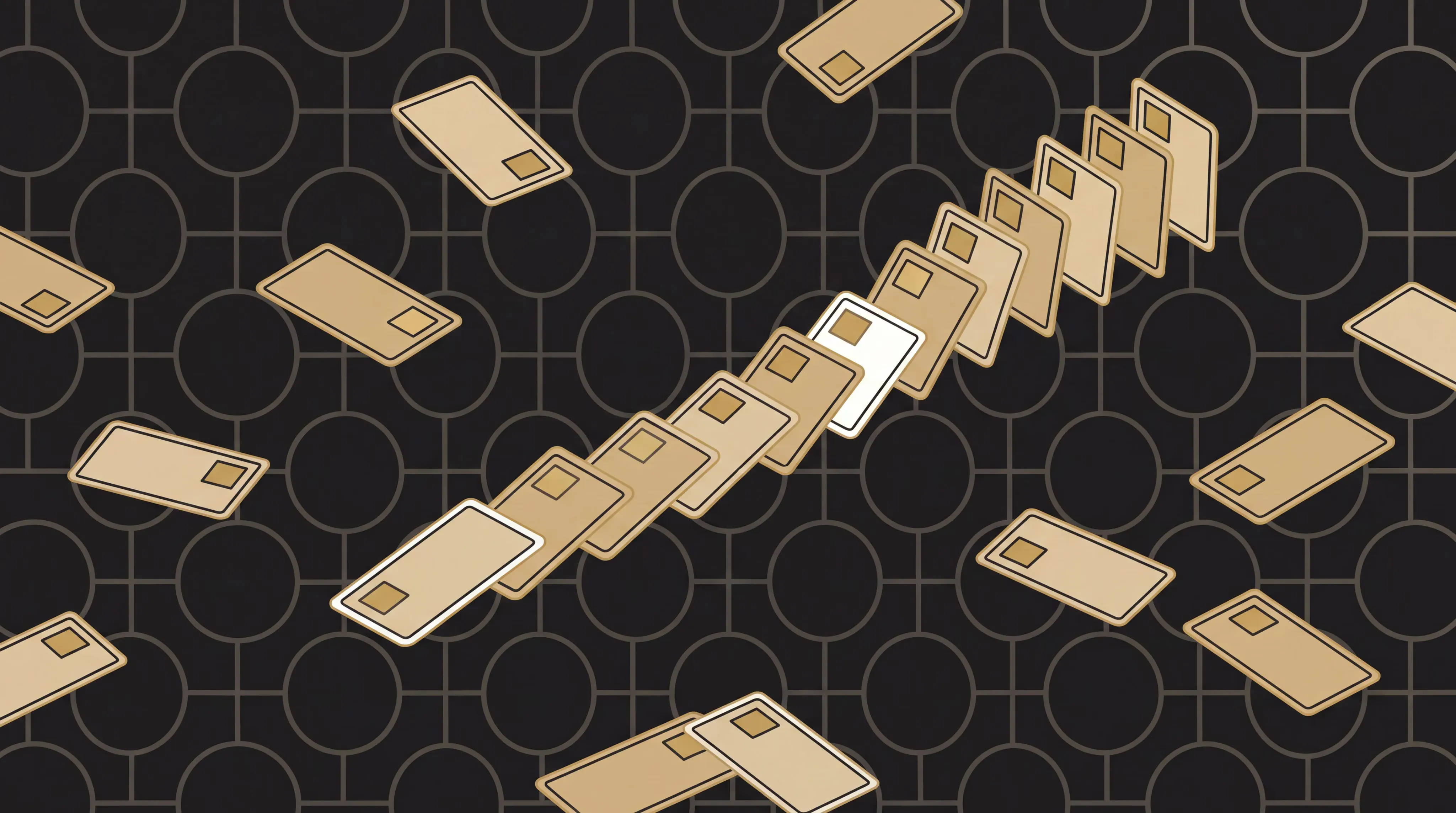
The cutouts variant of the Training and Generation lessons has had a serious refresh. If you haven’t tried this version with your students, now’s a good time.
Instead of building the whiteboard frequency grid, you print the bigram model as physical cards and scatter them face-up across a big table. Each card shows a prefix (the word that came before) and a token (the word that follows). To generate text: scan for a card whose prefix matches your last-written word, write its token, then hunt for the next match. The chain grows like dominoes.
The trick is in the scanning. Every token has its own colour, repeated wherever it appears: as a prefix box on one card, as a free-standing token on another. To match a prefix against your last word, your eye hunts for that word’s colour on the right edge of a card. Verify the actual token before committing, since colours sometimes collide.
This gives you weighted random sampling for
free. If eggs follows green 40% of the time in the training text, then 40%
of the matching cards will say eggs. Whichever card your eye lands on, you’ve
sampled in proportion to the empirical distribution. No dice, no probability
tables: the spread is doing the maths.
That’s the main argument for choosing the cutouts over the grid version of the lesson. The cutouts skip the explicit weighted-sampling step, which is the conceptually heaviest moment in the unplugged sequence. They also parallelise better: a class of thirty splits into seven groups around their own table-spreads, where the grid bottlenecks at one teacher. The costs are a colour printer (essential, since the colour coding is doing real work), scissors, and more table than the grid wants. For primary-age students the cutouts are the easier sell, and the weighted-sampling-without-the-maths trick still lands well with adults.
The tools page has three ready-to-print PDFs: Green Eggs and Ham, Where Is the Green Sheep?, and We’re Going on a Bear Hunt. They’re designed for A4 colour printing, pre-rotated for double-sided output so the same cards appear on both faces of each sheet and students never have to flip a face-down card. Each PDF includes an instructions page with a labelled card and a domino chain showing how each token becomes the next card’s rightmost prefix. The same tools page lets you generate cutouts from any text you like.
Both bigram (n=2) and trigram (n=3) configurations work, and you can push to n=4 or beyond. The More Context lesson walks through the trade-off: bigger n produces text that reads more like the source, at the cost of a much bigger spread. Cutouts let you see this trade-off as physical paper rather than an abstract claim.
If you can’t print colour, or your students respond better to a tighter board-style activity, the grid versions of Training and Generation are still here, still good. Both variants land at the same understanding by different paths. Try the cutouts.