No public sessions are scheduled right now —
get in touch to arrange one.
LLMs Unplugged is a set of hands-on teaching resources that
demonstrate how
LLM (Large Language Model)A language model trained on a very large amount of text, with billions of parameters. The hand-built models in these lessons are tiny language models; ChatGPT, Claude and Gemini are large ones. The core principles are identical. The difference is scale.
View in glossary
work—no
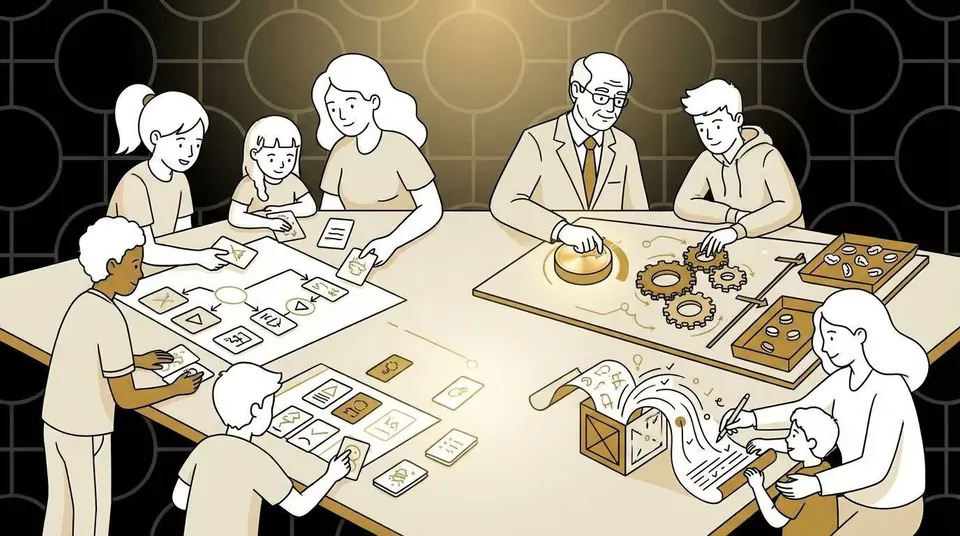
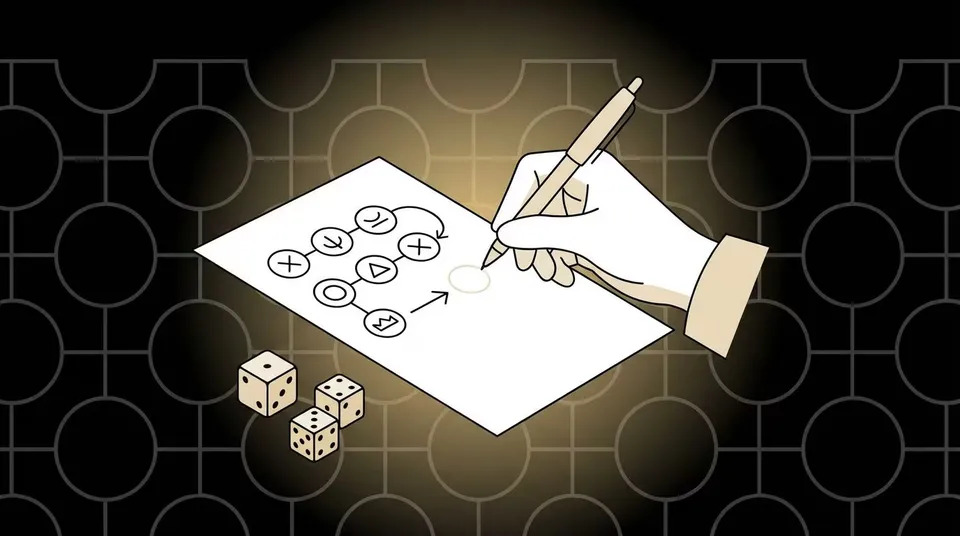
computers or coding required. You count word patterns in a text, record
them as tally marks on GridA sheet of grid paper with the vocabulary written down the side and across the top. Training fills each cell with tally marks for how often the row's word was followed by the column's word; generation reads a row and rolls against it. It's the original LLMs Unplugged apparatus.
View in glossary
or physical piles of paper
CutoutsPrinted cards, one per word pair in the text, each showing a previous word in a box and the word that followed it. Spread on a table they are the model: to generate, find a card whose boxed word matches your current word and read off its next word. Common pairs appear on more cards, so picking by eye samples in proportion.
View in glossary
, then roll dice to
generate new text from those patterns. After building a
Language modelA system that predicts what text comes next, using patterns learned from training data. Your hand-built grid, a cutouts spread, a booklet, and a room holding search sheets are all language models.
View in glossary
by hand,
something clicks: you see that tools like
Chatbot (ChatGPT, Claude, Gemini)A product that wraps an LLM in a conversation. ChatGPT is OpenAI's, Claude is Anthropic's, Gemini is Google's, and there are many others. On this site we often name ChatGPT or Claude as shorthand for any of them: the concepts apply equally to every modern LLM chatbot, whichever one you use.
View in glossary
work using
the same basic principles, just at a vastly larger scale.
Since ChatGPT arrived in November
2022, (most) everyone's using
, yet most people have no
real mental model of what's actually happening under the hood.
Understanding how these systems work—not through metaphor or
handwaving but through direct experience—is what we're all
about. These resources don't tell you or your students what to think
about the role of AI in society; they give you a grounding for having
that discussion, informed by having done it yourself. No coding, no
maths beyond counting and percentages, and it works from primary
school to the boardroom. More in the FAQ.
Can it work with a whole hall?
In a workshop everyone builds their own model, but the same idea works
as a fifteen-minute talk. At the ANU Visionaries Among Us Showcase in
August 2026 we handed each of about 360 people a
search sheet, and the hall spent
four minutes writing a sentence by show of hands, one word at a time.
The slides, sheets and running order are on the
talk page.
Who made this?
LLMs Unplugged is a
Cybernetic Studio
project created by Dr. Ben Swift
(PhD Computer Science, 2012) at the ANU School of Cybernetics. But if
you're worried that you'll need a PhD in Computer Science to
understand it, rest assured—the whole point of these resources
is to demonstrate that you don't. There's more on the lineage, from CS
Unplugged back to Shannon, on the about page.
Contact
If you have questions, success stories about using these materials, or
would like to discuss adaptations or improvements you've made, get in
touch at
ben.swift@anu.edu.au. If
you'd like to hear about what cool stuff is going on at the School of
Cybernetics, then sign up for the
mailing list
.