#About
LLMs Unplugged is a Cybernetic Studio project created by Dr. Ben Swift at the ANU School of Cybernetics. If you’ve got questions, suggestions, or LLMs Unplugged success stories then send Ben an email.
These resources build on a rich history of unplugged computing education (and hands-on education in general). If you’re interested in where these ideas came from—or where to go next—this is the reading list.
#CS Unplugged
For over two decades, CS Unplugged has demonstrated that core computing concepts can be taught effectively without computers. Through carefully designed hands-on activities, learners from primary school through to adult education have explored algorithms, data structures, and computational thinking. The approach strips away the distractions of syntax and tooling, allowing learners to focus on underlying principles.
More importantly: it works (the literature has receipts). Making learning these concepts both effective and fun turns is possible, and CS Unplugged proved has proven that at scale.
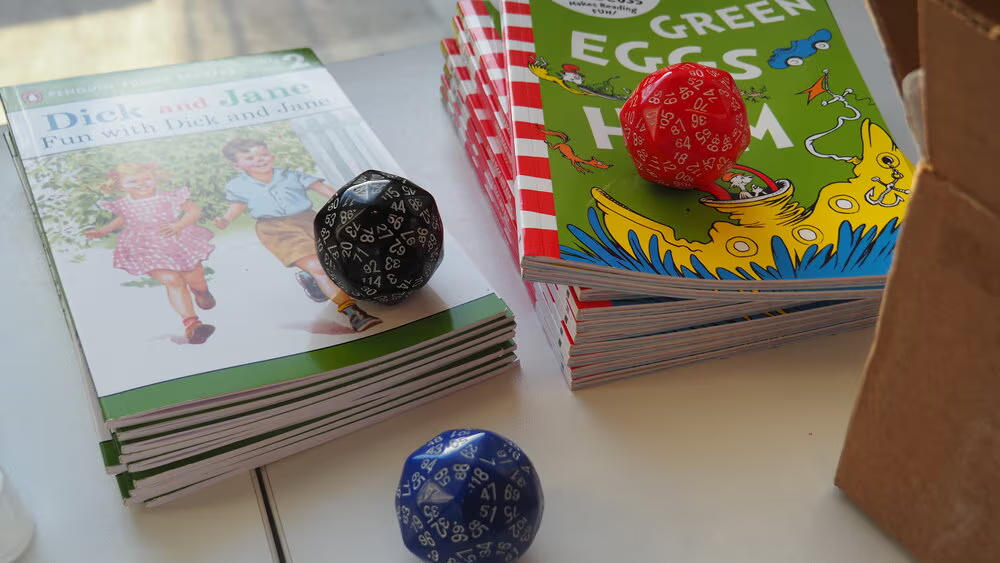
LLMs Unplugged applies this same philosophy to language models. Rather than explaining transformers through mathematics or implementing neural networks in code, participants count word patterns in a text, record them as tally marks on grid paper or physical piles of paper cutouts, then roll dice to generate new text from those patterns. This hands-on approach makes sophisticated AI concepts accessible to anyone, regardless of technical background.
#AI Unplugged resources
As machine learning and artificial intelligence became more prominent in public discourse, educators naturally extended the unplugged approach to these fields, for example:
- AI Unplugged by Lindner, Seegerer and Romeike
- Northwestern University’s AI Unplugged Resources
- CS In Schools by Toan Huynh and Hugh Williams has some material on AI Unplugged1
These collections cover classification, clustering, computer vision, and artificial neural network concepts. However, they contain limited material specifically about language models and especially text generation—a gap that became particularly acute after ChatGPT’s November 2022 release shifted what “AI” means to most people. LLMs Unplugged aims to fill that gap.
#Historical foundations
The n-gram language models participants build in these workshops have a lineage stretching back over a century. This isn’t new theory—it’s well-established mathematics applied by hand.
#Markov’s stochastic processes (1913)
Andrey Markov introduced the mathematics of what we now call “Markov chains” while analysing letter sequences in Pushkin’s Eugene Onegin. His work established that language has statistical structure you can quantify through counting patterns and calculating probabilities. Though Markov’s interest was purely mathematical, his framework for modelling sequences of dependent random variables became foundational to computational linguistics.
#Shannon’s information theory (1948–1951)
Claude Shannon built directly on Markov’s foundation, applying his new information theory to written English. Shannon used n-gram models to measure entropy and redundancy in language, connecting statistical patterns to fundamental limits on compression.
Crucially, Shannon was the first to systematically generate synthetic text using these models—starting with random letters (0-gram), then letter frequencies (1-gram), then letter pairs (2-gram), and progressively higher orders. This generative approach revealed how increasing context length produces increasingly realistic text, a finding that remains central to modern language models.
Here’s the thing: Shannon’s work was itself “unplugged”. He counted transitions by hand, calculated probabilities manually, and generated synthetic text using hand-drawn tables and selection based on frequencies. Modern LLMs use the same fundamental approach but at vastly greater scale and with learned rather than hand-crafted statistics.
#Connection to modern LLMs
The activities in LLMs Unplugged demonstrate the same operations used in current language models. The differences are mostly about scale:
- parameters: hand-built models have dozens to hundreds versus billions in modern LLMs, but the core concepts remain identical
- training: manual counting versus automated pattern detection, but both processes learn probability distributions from text
- generation: dice rolls versus GPU-accelerated sampling, but both use weighted randomness to select the next token
- context windows: bigrams and trigrams versus 128,000+ token windows, but longer context always enables better prediction
Modern advances come from doing these same operations at massive scale with neural networks that learn patterns automatically. But the fundamental insight—that language structure can be captured through statistical dependencies and revealed through synthetic generation—comes directly from Shannon’s mid-twentieth-century work and the unplugged methods he used to explore these ideas.
Which is to say: when you’re rolling dice and generating sentences in an LLMs Unplugged workshop, you’re not just learning about modern AI. You’re also participating in a tradition of hands-on exploration that goes back to the origins of information theory itself.
#About the ANU School of Cybernetics
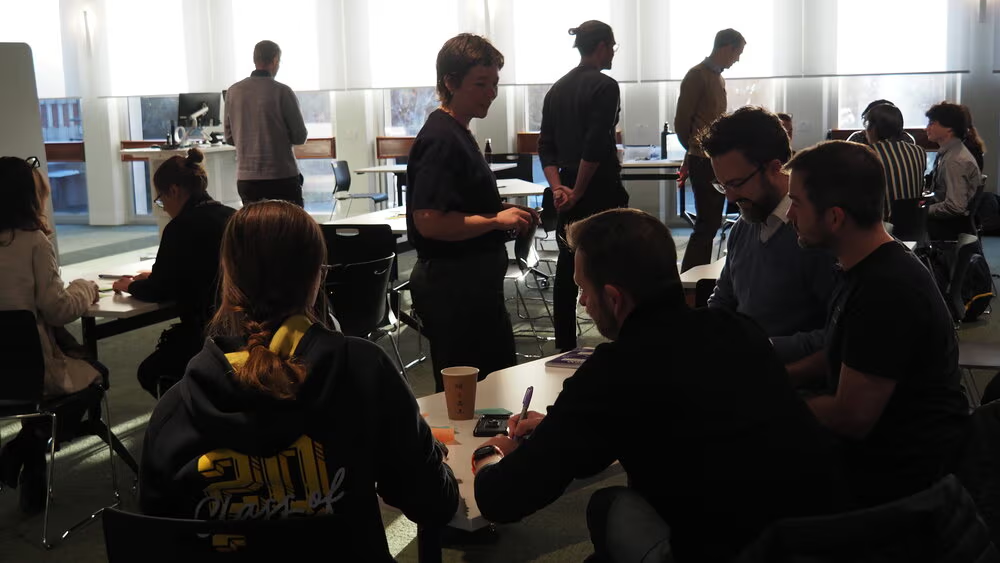
The School of Cybernetics at the Australian National University takes a systems-oriented approach to understanding and shaping technology in society. The School’s Cybernetic Studio develops hands-on resources and runs workshops exploring the social, technical, and political dimensions of emerging technologies.
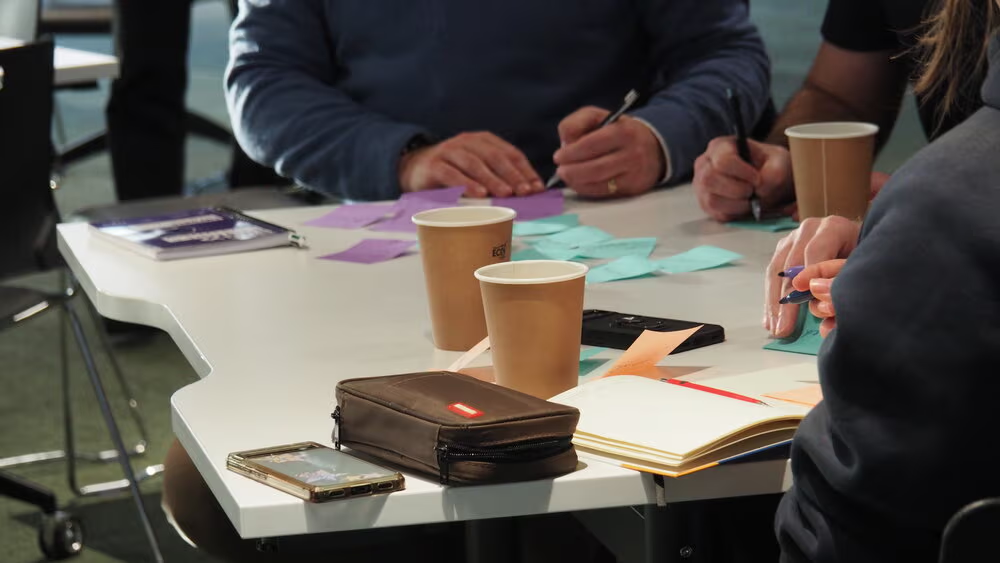
LLMs Unplugged reflects the School’s commitment to making sophisticated technical concepts accessible to diverse audiences and fostering critical engagement with AI systems that increasingly mediate how we work, learn, and communicate. Understanding how these systems actually work—not through metaphor or handwaving but through direct experience—is what we’re all about.
#Acknowledgements
This work has benefited enormously from the input and facilitation help of Eddie Aloise King and Cole Cooney and other SoCy staff, plus feedback from hundreds of participants across diverse audiences—school students through to senior executives in the Australian Public Service. Iterating on these materials with real learners has been invaluable.
#Get in touch
We encourage educators to use, adapt, and improve these resources. If you have questions, success stories about using them in your classroom, or would like to discuss adaptations improvements you’ve made, get in touch at ben.swift@anu.edu.au—we’d love2 to hear from you. And if you’d like to be informed of more cool stuff coming out of the School of Cybernetics, then sign up for the mailing list.
#Citation
If you use these materials in your teaching or research, please cite them as:
#APA
Swift, B. (2025). LLMs Unplugged: Understand how AI language models work by building one yourself. Zenodo. https://doi.org/10.5281/zenodo.17403824
#BibTeX
@misc{swift2025llmsunplugged,
  author       = {Swift, Ben},
  title        = {{LLMs Unplugged: Understand how AI language models work by building one yourself}},
  year         = 2025,
  publisher    = {Zenodo},
  doi          = {10.5281/zenodo.17403824},
  url          = {https://doi.org/10.5281/zenodo.17403824}
}- There's one activity on Generative AI worksheet that uses a similar "counting bigrams" approach to the Basic Training lesson
- well, technically that's a requirement of the SA clause in the CC licence, but it's still true that we'd love hearing about your changes :)