For educators

Lesson plan 1: LLMs Unplugged Fundamentals
- time: 90mins
- for ages: 12+
This core workshop covers the essential training-to-generation pipeline. Start with a brief introduction to set the scene, then move through training a model, generating text from it, and finally exploring what happens when you use a larger pre-trained model. Each step builds on the last, giving students a complete picture of how language models work.

Introduction
What is a language model, and why learn about them with pen, paper, and dice?

Training
Build a bigram language model that tracks which words follow which other words in text.

Generation
Use your hand-built bigram model to generate new text through weighted random sampling.

Pre-trained Model Generation
Use a provided pre-trained booklet to generate text without training your own model.
Suggested timing
- 00:20 Intro
- 00:20 Training
- 00:40 Generation
- 01:00 Pre-trained model generation
- 01:20 close — how has this workshop changed how you think about language models? how has this workshop changed how you will use language models?
Notes for Fundamentals
- this outline doesn’t include the Weighted randomness lesson, but if your students aren’t so familiar with that stuff then you could add it in before the Training lesson (add another 30mins)
- once you get to the Generation lesson and beyond, get students to do “dramatic readings” as they share back the text their new language models have generated...
- if you have a bit longer, then adding the Sampling lesson at the end is a fun option—it builds on either the Generation or the Pre-trained model generation work and shows how different parts of the “LLM process” can have different effects on the output
Lesson plan 2: going deeper
- time: 2–3 hours (or split across sessions)
- for ages: senior high school or particularly engaged groups
For students ready to go further, this extended trajectory adds the “how models understand” topic. After covering the fundamentals, you explore how models can track grammatical context and how words get represented as numerical vectors. This path suits later-year high school students, computing electives, or keen beans who want to understand what “ Attention mechanism The ability to focus on relevant previous words when making predictions. In real LLMs, attention is learned, weighted, and dynamic---the model decides what to focus on for each prediction. Context columns illustrate the motivation for attention: considering more than just the immediately preceding word. View in glossary ” and “ Embedding A numerical representation of a word. Each row in your bigram grid is that word's embedding vector---a fingerprint of its usage context. In real LLMs, embeddings are learned separately rather than derived from raw counts, but the principle is the same: words used in similar ways get similar vectors. View in glossary ” actually mean.
Introduction
What is a language model, and why learn about them with pen, paper, and dice?
Training
Build a bigram language model that tracks which words follow which other words in text.
Generation
Use your hand-built bigram model to generate new text through weighted random sampling.
Pre-trained Model Generation
Use a provided pre-trained booklet to generate text without training your own model.

Context Columns
Add context columns to your bigram model to capture grammatical patterns, then use them during generation.
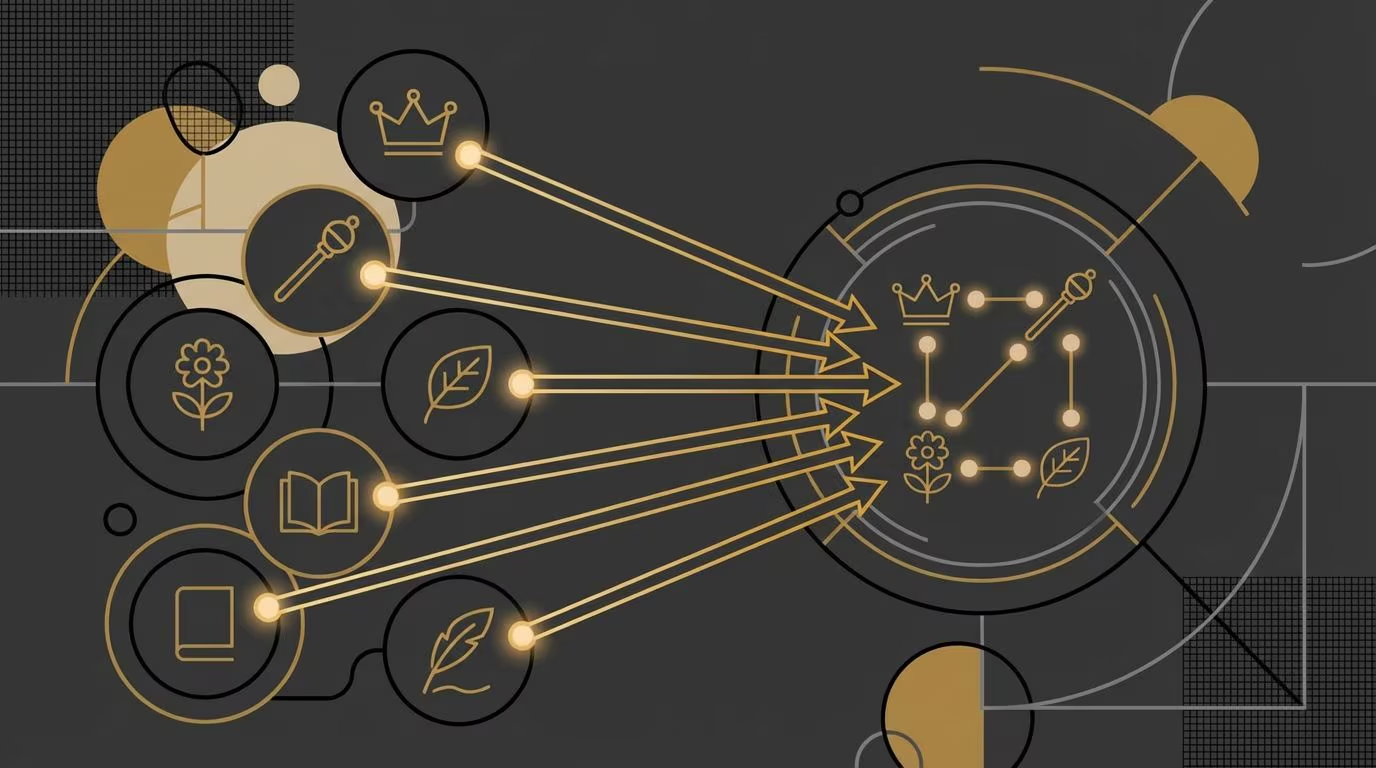
Word Embeddings
Turn each word's row into a vector and measure similarities between words in your model.
What these additions cover
- Context columns extends the basic bigram model with extra columns that track grammatical categories (is the previous word a verb? a pronoun? a preposition?). This is a hand-crafted version of what transformer “attention” learns automatically—the idea that type of context matters, not just which specific word came before.
- Word embeddings turns each word’s row in the model into a numerical vector and measures similarities between words. Words that behave similarly in the training text end up close together. This is the foundation of how modern LLMs represent meaning—and students can calculate it by hand.
Why split the trajectory?
The fundamentals work for any audience and require only 90 minutes. The “understanding” lessons require more time and comfort with abstraction, but they connect directly to concepts students will encounter in any deeper study of AI: attention mechanisms, embeddings, vector similarity. Running them as a second session (or a follow-up for interested students) keeps the core workshop accessible while offering a clear path forward.
Lesson plan 3: controlling output
- time: 30mins (as an add-on)
- for ages: 14+
Once students can generate text, a natural question is: “How do you make it more or less creative?” The sampling lesson shows how temperature and truncation strategies change the character of output without changing the model itself. This is a quick add-on to either the fundamentals or the deeper trajectory.

This lesson explains:
- temperature: how dividing counts by a temperature value flattens or sharpens the distribution, making surprising words more or less likely
- truncation: strategies like greedy selection, no-repeat, or even haiku constraints that narrow which words are eligible before sampling
Students discover that “creativity” in AI comes from two controls: adjusting probability distributions and filtering which tokens to consider. The same model can produce cautious prose or wild poetry just by tweaking these parameters.
Adaptation and data
For classes focused on data science, ethics, or media literacy, the “Adaptation and data” topic explores what happens when models train on their own output.
The Synthetic data lesson is particularly effective for discussions about:
- AI-generated content flooding the internet
- model collapse and why training data quality matters
- the difference between human-written and AI-generated text
This works well as a standalone activity after students have done basic training and generation, or as part of a broader unit on AI ethics and media literacy.