#Frequently asked questions
#Why do you keep saying LLMs—this is AI, right?

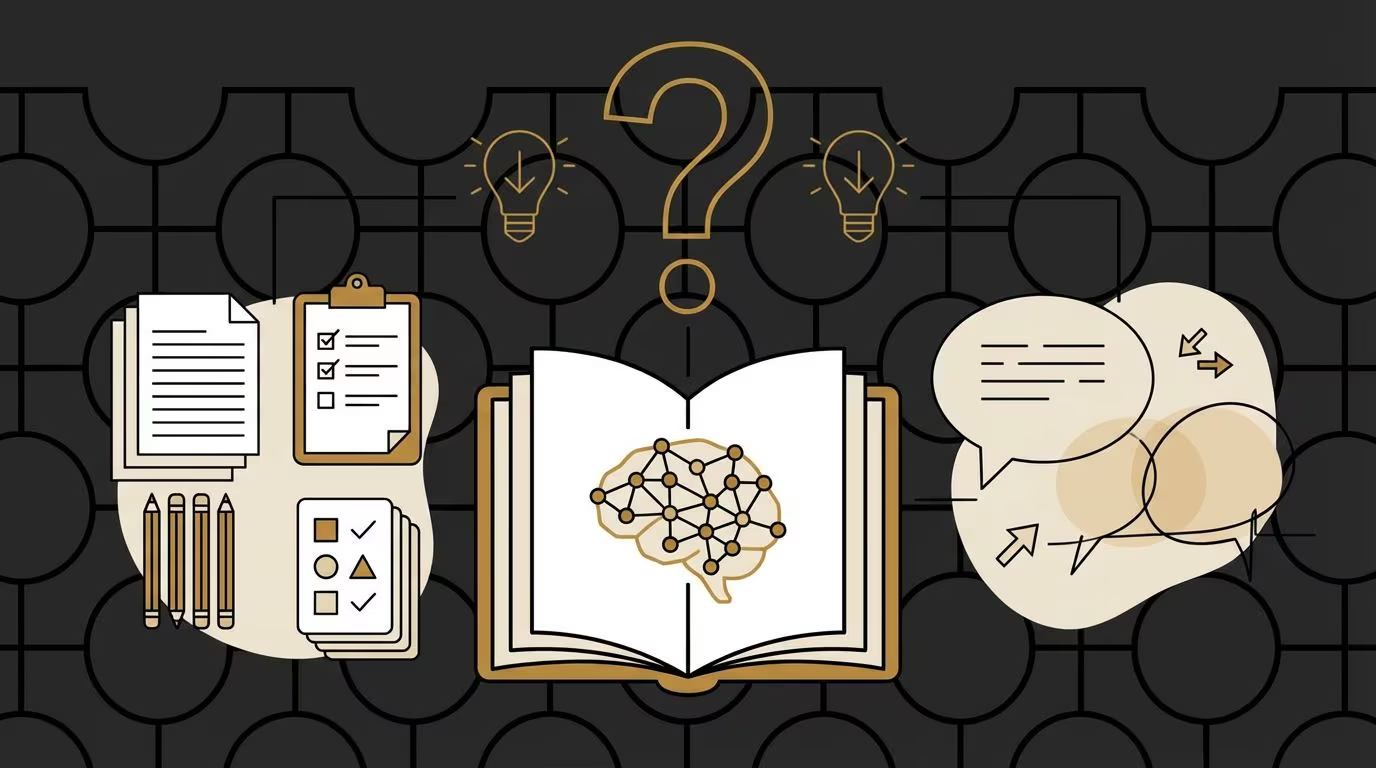
Honestly, the short answer (these days) is yes. The long answer is more more complicated—AI is a term that has been applied to many different algorithmic techniques and systems over the years. But today (in the mid-2020s) Large Language Models have kindof sucked all the air out of the room when it comes to AI, so that’s mostly what we’re talking about here. I (Ben) do like to use the term LLM rather than AI whenever I can, because I think it’s more specific and accurate.
#You mention ChatGPT and Claude a lot, but Gemini/DeepSeek/etc. is more my jam
None of these resources are specific to any particular LLM product. We sometimes use “ChatGPT” or “Claude” as shorthand because they’re the names most people recognise, but the concepts apply equally to any modern LLM.
#Who is this for?
Anyone curious about how language models work. The activities are designed for learners from high school age upwards, with no technical background required. Educators, students, and professionals have all found value in the hands-on approach.
#Did some of this stuff used to be called “My First Language Model”?
Yep, it sure did… and we still sometimes use that as a workshop title at the ANU. But this website and resources are for all the LLMs Unplugged resources, not just the ones we use in that particular workshop.
#Do I need any special materials?
Nope, it’s all stuff you’ll have around the office/house/classroom. Each lesson has a “you will need” section.
#Are there any video resources to accompany the lessons?
Not yet, but we’re working on it—stay tuned.
#Are there printable versions of the lessons?
Yes. We have a combined lessons PDF containing printable student handouts for all lessons. The web versions of lessons are more up-to-date and feature-rich, so we recommend using them when possible, but the PDF is handy for offline use or classroom printing.
#Can I use these materials in my school classroom?
Yes. All materials are released under CC BY-NC-SA 4.0, so you can use, adapt, and share them for non-commercial educational purposes with attribution.
#Can I use these materials in a paid workshop?
The NC (Non-Commercial) clause in our licence has some ambiguity around paid educational activities. Our intention is that educators at schools, universities, and non-profit organisations can use these materials in workshops that charge cost-recovery fees. However, for-profit companies cannot run paid workshops using these materials under the CC BY-NC-SA 4.0 license. If you’re a commercial training provider interested in using these resources, please contact us—we’re happy to discuss alternative licensing arrangements.
#I’m a corporate client, and I’d love to have some experts come and deliver this workshop for us
Good news—that’s one of the things we do here at the School of Cybernetics. Drop us a line and to discuss how we can make it happen.
Honestly, this stuff is just as fun as a Christmas party/team bonding activity, but the learning is very real. Learning can be fun.
#Why dice and buckets instead of computers?
Using physical randomness makes the probabilistic nature of text generation tangible. When you roll dice and look up words in a table, you’re doing exactly what a computer does—just slower. This builds genuine understanding rather than treating AI as a black box.
#How do these activities relate to ChatGPT, Claude, and other LLMs?
Modern LLMs use the same fundamental principle: predict the next token based on context. The differences are scale (billions of parameters vs dozens) and learned vs hand-counted statistics. The core mechanism—weighted random selection based on patterns in training data—is identical.
#Can I generate my own booklets from custom text?
Yes. You can generate booklets online directly in your browser—no installation required. Just upload or paste your text, choose your options, and download a PDF. Your text is processed entirely in your browser and never sent to any server.
If you prefer working offline or want to modify the tools, the source code includes a command-line tool that provides the same functionality.
#Is there a research paper about LLMs Unplugged?
Yes. LLMs Unplugged was presented at the 28th Australasian Computing Education Conference (ACE 2026) in Melbourne, Australia. Download the paper here.
#BibTeX
@inproceedings{swift2026llmsunplugged,
  author    = {Swift, Ben},
  title     = {{LLMs Unplugged: Teaching Resources for a ChatGPT World}},
  booktitle = {28th Australasian Computing Education Conference (ACE 2026)},
  year      = 2026,
  month     = feb,
  address   = {Melbourne, VIC, Australia},
  publisher = {ACM},
  doi       = {10.1145/3786228.3786237},
  url       = {https://doi.org/10.1145/3786228.3786237}
}#I found an error in the materials.
Please open an issue on GitHub or contact us. We appreciate corrections and suggestions.