Search Sheets
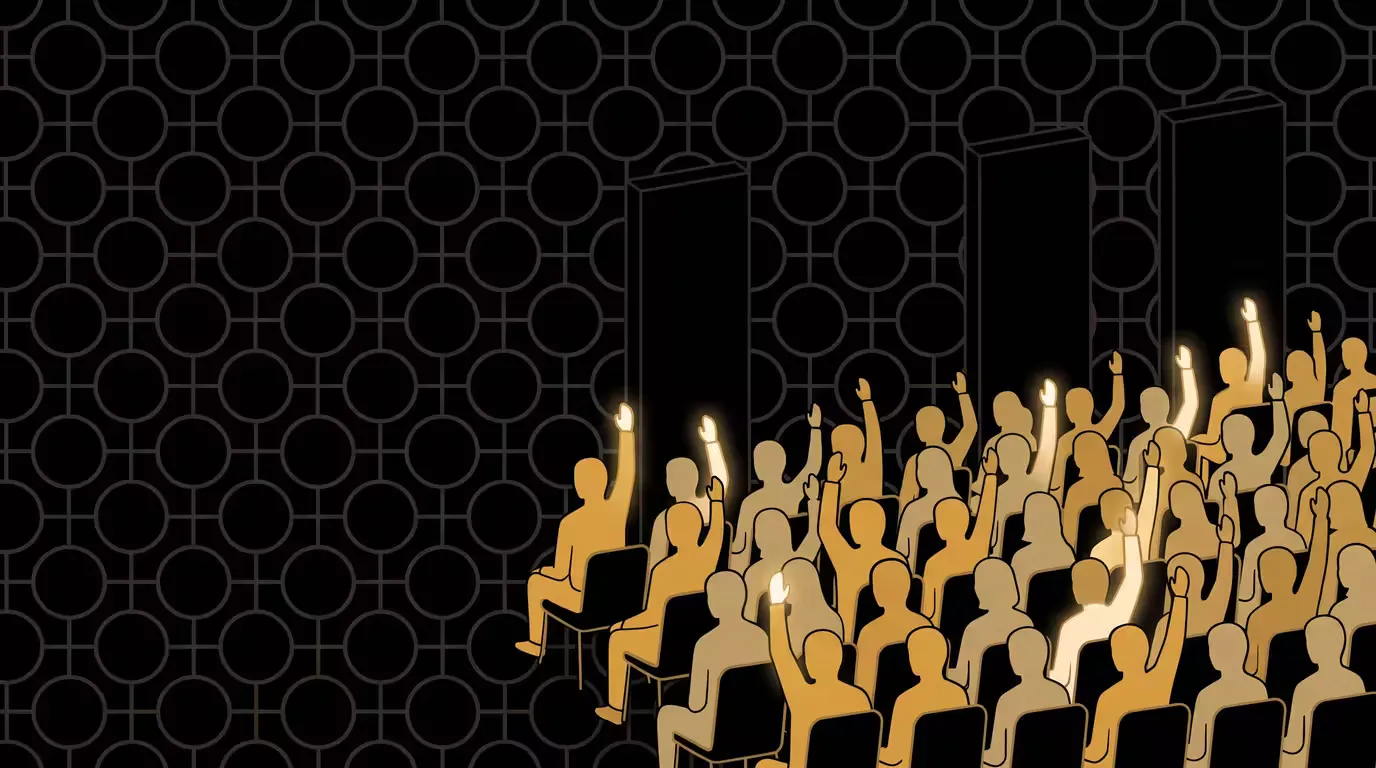
Key idea: Nobody holds the whole model. Each sheet is a slice of it, the show of hands is the probability distribution, and the random pick is the sample.
Used in Demystifying large language models (talk) and Unplugged in the age of AI (talk) --- ready-to-run lessons and talks that include this module.
The cutouts activity with the cutting taken out, and sized for a room rather than a table. Every token pair in a text is dealt to exactly one person, so the Language model A system that predicts what text comes next, using patterns learned from training data. Your hand-built grid, a cutouts spread, a booklet, and a room holding search sheets are all language models. View in glossary only exists across the whole room, which then runs it one word at a time with hands in the air.
You will need
- one Search sheets A whole-room format: each person holds a sheet carrying a shuffled handful of word pairs from the text, and the room together is the model. Whoever is running it calls the current word, everyone holding it raises a hand, and one is picked. The show of hands is the probability distribution. View in glossary per person—the Materials page has ready-to-print sets, or generate your own from any text, sized to your head count
- a whiteboard (or a slide you can write on) for the growing text
- optionally a scribe, so you can run the room without also writing
Your goal
Generate a sentence, as a room, that appears in no book. Stretch goal: run it twice from the same seed and compare the two sentences.
Key idea
Each sheet holds a shuffled handful of
Token
A single unit of text that the model works with. In our activities each word and punctuation mark is a token. Modern LLMs use subword tokens, so a long or unusual word may be split into several.
View in glossary
pairs from the text: a boxed
previous word and the word that followed it. No single sheet can continue the
text on its own. But ask the room “who has the?” and a forest of hands goes
up; ask for a rare word and you get two. The number of hands for each
continuation is how often it happens in the text—so the show of hands is the
Probability distribution
A set of options with a likelihood attached to each. The counts in one row of your grid, the matching cutouts on a spread, or the show of hands when the room is asked "who has `the`?" are all probability distributions over the next word.
View in glossary
, without anyone counting anything. Pick a hand at random and you’ve sampled
from it.
The algorithm
- Call out the last word written on the board (and its colour—every word keeps the same colour wherever it appears, so people scan by colour and confirm by reading).
- Hands up if that word appears as the boxed word on your sheet.
- Pick a hand at random; that person reads out the word beside it.
- Write it down, and go again from step 1.
Keep going until you have a sentence or two (about fifteen words), then read it back.
Running it
- don’t hand the sheets out too early. They get read, and if you’re keeping the text a secret (see below) the reveal is worth protecting
- seed from the room: ask a volunteer to read out any one pair from their sheet, boxed word first, and write both up. The room supplies the first two words as well as every word after them. If their pair is an odd one (a full stop, a name that appears once), take it anyway: a thin first round is a real property of the model
- pick at random. Take the first hand up and you’re sampling the quickest reader in the room instead of the text. Random is what makes the room behave like the model
- one hand each. If someone has several matches, they go with the first one they spot. (A context more common than the room is big has to double up somewhere, which flattens the busiest words slightly; nobody will notice)
- it can’t dead-end. Every word in the text appears as a boxed word somewhere, so there is no word you can call that has nothing following it. The only way the room goes quiet is an empty seat—that person’s sheet went home with them, and its pairs are gone. Say exactly that, and reseed
- narrate two things, once each, without stopping the flow: the hands are
the distribution (say
theand most of the room goes up); and the choosing is a coin toss—the hands you didn’t pick were all real continuations, and a different pick gives a different sentence, which is why the “regenerate” button gives you a different answer - stop while they still want more, and read the sentence back
Naming the parts
Everything the jargon describes, the room just did:
- each word on your sheet → a
- the sheets, together → the Parameters The numbers a model stores to encode what it has learned. Each cell of your grid, holding the count for one word pair, is a parameter. A modern LLM has billions of them, and a frontier model on the order of a trillion. View in glossary of the
- the hands in the air → the over next tokens
- the random pick → Weighted random sampling Choosing the next token with probability proportional to its count. A d10 roll against the counts does this, and so does letting your eye land on one of the matching cutouts, because common words appear on more of them. View in glossary
- the sentence on the board → Generation Using a trained model to produce new text by repeatedly predicting and choosing the next token. Look up the current word, pick a next word in proportion to the counts, write it down, repeat. View in glossary
And the sentence is in no book: nobody wrote it, and there was no lookup and no database of sentences. It came out of a pile of paper and a series of random picks.
Variations
- Mystery text. Print the sheets with the title and author left off, and
don’t say what the text is until the end. With two or three short books dealt
together, the room can’t tell which pairs came from which—and the generated
sentence drifts between them mid-sentence through shared words like
theand.. Reveal the books last. - Sorted sheets. A second round with each sheet sorted by context instead of shuffled turns every sheet into a lookup table. The room feels how much faster search gets, which is what a computer’s index is for.
- The grid form. Follow it with one line of the same text as a
grid: every pair from the sheets is a tally mark in a
cell, and the
merow with two marks under!and one undernowis three hands going up, two of them saying the same thing. - The workshop version. This is a model handed to a room; in Training and Generation each table builds its own from scratch and takes it home.
Instructor notes
Where it fits
Search sheets are the fastest way to run generation with a big group: no training, no scissors, no table space, five minutes from hand-out to a sentence. We use them to turn a talk into an activity (a lecture theatre, a conference session, a hall of several hundred) and they were designed at a teacher’s request for a thirty-minute primary lesson with no time to cut. What you give up is the building: nobody trained this model, so pair them with Training when there’s time.
Discussion questions
- where was the model? (it wasn’t on a laptop, or on any one sheet)
- why did
theput so many hands up andskiffonly two? - if we’d taken the fastest hand every time, whose model would we have been running?
- the same seed twice gave two different sentences. What changed?
- our model only ever looked at one word back. What did that do to the sentence, and what would looking further back fix?
Connection to current LLMs
The room ran the actual mechanism, at human speed. A frontier model differs in three ways worth saying out loud:
- it looks at more than one word of
Context window
How many previous tokens the model can consider when it predicts the next one. A bigram has a context window of one word and a trigram of two; modern LLMs can consider hundreds of thousands or even millions of tokens.
View in glossary
. One word back is why the room’s
sentence wandered: when you called
the, nobody could tell whether the text had just said “sat in the” or “hit the”. A real model looks back over the whole conversation (More Context is the next step). - it can say what it never saw. The room rates any pair not on a sheet as
flatly impossible. A real model spreads what it learns across billions of
numbers instead of separate cells, so what it learns about
catreachesdog(Word Embeddings). - it’s been taught to answer. Ask the room a question and it continues the question. Turning that into something that answers you is another round of Post-training Everything done to a model after pre-training to make it useful. Pre-training teaches the model how language works; post-training shapes its behaviour: following instructions, answering rather than continuing, refusing some requests, working carefully through problems. Supervised fine-tuning (imitating example conversations), RLHF and RLVR are all post-training techniques. View in glossary , on conversations (RLHF).
None of those changes the loop: look at the context, weigh the options, pick one, write it down. Every reply from Chatbot (ChatGPT, Claude, Gemini) A product that wraps an LLM in a conversation. ChatGPT is OpenAI's, Claude is Anthropic's, Gemini is Google's, and there are many others. On this site we often name ChatGPT or Claude as shorthand for any of them: the concepts apply equally to every modern LLM chatbot, whichever one you use. View in glossary is produced one token at a time that way. The scale is the other difference: a room of thirty holds a couple of thousand token pairs, and a frontier model holds on the order of a trillion learned numbers. It doesn’t make you an expert. It does make you harder to fool.