Weighted Randomness
Key idea: Use weighted sampling to make random choices that reflect a target probability distribution.
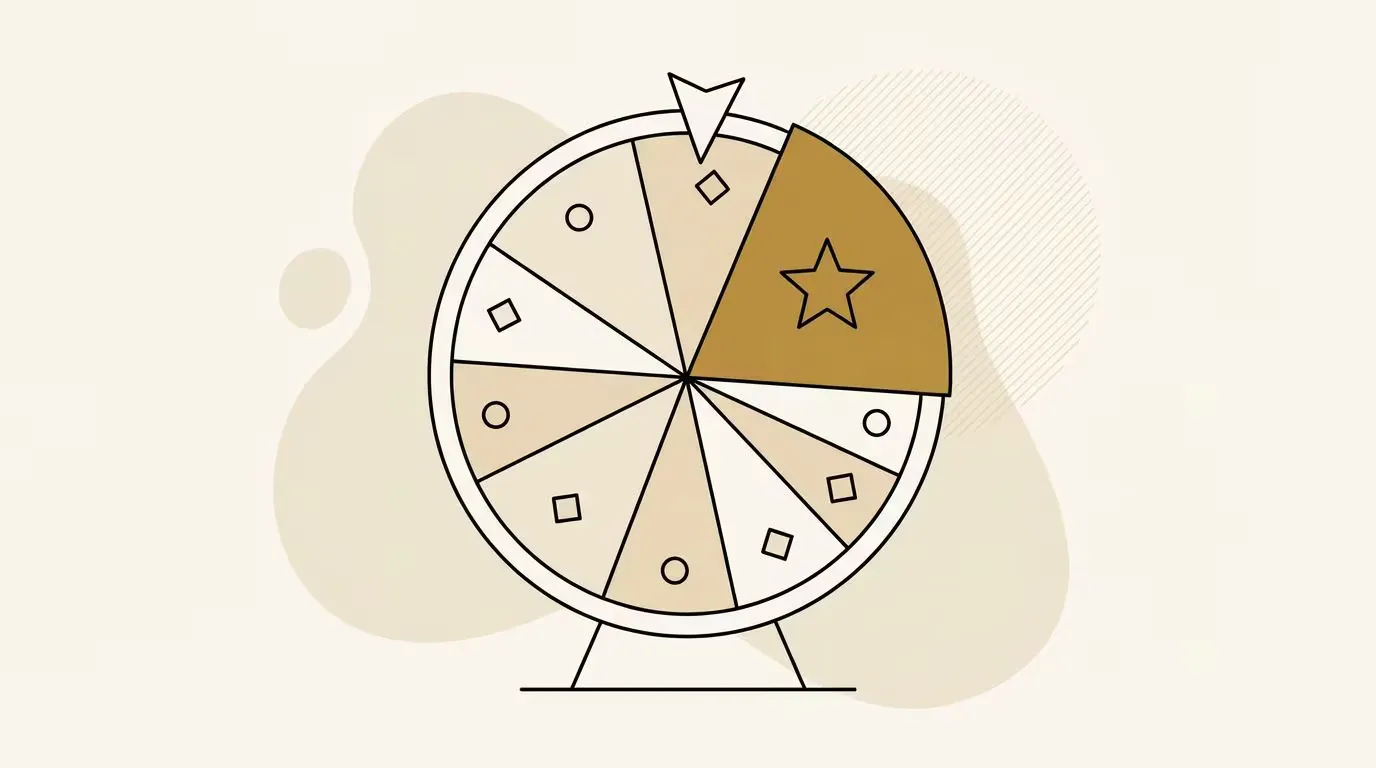
Learn how to make Weighted random sampling Choosing the next token with probability proportional to its count. A d10 roll against the counts does this, and so does letting your eye land on one of the matching cutouts, because common words appear on more of them. View in glossary choices where some options are more likely than others—an operation at the core of all generative AI.
You will need
- 10-sided dice (d10)
- coloured marbles or beads in a bag
Your goal
Randomly choose from a fixed set of outcomes according to a given Probability distribution A set of options with a likelihood attached to each. The counts in one row of your grid, the matching cutouts on a spread, or the show of hands when the room is asked "who has `the`?" are all probability distributions over the next word. View in glossary .
Key idea
Sometimes we need to make random choices where some outcomes are more likely than others. There are simple ways to do this while keeping the average outcome proportions close to the probabilities you choose.
Algorithm 1: beads in a bag
- materials: coloured beads, bag
- setup: count out a number of beads corresponding to the desired weights for each outcome
- sampling procedure: shake the bag, then draw one bead without looking
Example
You want to choose an ice cream flavour: vanilla 50% of the time, chocolate
30%, and strawberry 20%.
- add 5 white beads to the bag (vanilla)
- add 3 brown beads to the bag (chocolate)
- add 2 red beads to the bag (strawberry)
Draw a bead from the bag—that’s your ice-cream choice for today.
Algorithm 2: dice with ranges
- materials: d10 (or d6, d20 as alternatives)
- setup: assign number ranges proportional to weights
- sampling procedure: roll the die, then look up the corresponding outcome
Example
- for 60% vanilla / 40% chocolate, roll a d10: 1-6 means vanilla, 7-10 means chocolate
- for 50% vanilla / 30% chocolate / 20% strawberry, roll a d10: 1-5 means vanilla, 6-8 means chocolate, 9-10 means strawberry
You can use different dice (d6, d10, d20, d120, etc.); it just changes the number ranges corresponding to each outcome.
d10 roll-to-outcome mapping
A quick reference for common splits:
- 80/20: 1-8 for the 80% outcome, 9-10 for the 20%
- 70/30: 1-7 for the 70% outcome, 8-10 for the 30%
- 60/40: 1-6 for the 60% outcome, 7-10 for the 40%
- 50/30/20: 1-5 for 50%, 6-8 for 30%, 9-10 for 20%
Adjust the ranges to match whatever probabilities you need.
Instructor notes
Note: this is a warm-up. It’s usually fine to start straight from Training and come back here only if students want more detailed instruction about weighted random sampling.
Discussion questions
- which method feels most “random” to you, and why?
- which is fastest for getting repeated random selections?
- how would you handle weights like 17, 23, 41?
- what happens when one option has 95% probability?
- can you invent your own weighted random selection method?
Connection to current LLMs
This module introduces weighted random sampling before students encounter language models. While not specific to LLMs, this operation is fundamental to how they work:
- generation mechanism: every time an LLM (Large Language Model) A language model trained on a very large amount of text, with billions of parameters. The hand-built models in these lessons are tiny language models; ChatGPT, Claude and Gemini are large ones. The core principles are identical. The difference is scale. View in glossary produces a word, it’s performing weighted random sampling from a probability distribution
- probability distributions: Neural network A computational system, loosely inspired by biological neurons, that learns patterns from data by adjusting numerical weights. Modern LLMs are very large neural networks. Your hand-built model is not one, but it stores the same kind of information: which words tend to follow which. View in glossary output probabilities for thousands of possible next Token A single unit of text that the model works with. In our activities each word and punctuation mark is a token. Modern LLMs use subword tokens, so a long or unusual word may be split into several. View in glossary ; these probabilities become the “weights” for sampling
- physical intuition: dice and tokens make the mathematics tangible—when students later learn about “sampling from a distribution,” they’ll have hands-on experience with what that means
The key insight: weighted randomness is a general computational technique with applications far beyond language models (simulations, games, procedural generation). In the context of language models, this same operation happens billions of times during text generation. These physical methods (dice, tokens) implement the exact same mathematical operation that occurs inside LLMs when they choose the next word.