LLMs Unplugged for political scientists

Last Thursday we took LLMs Unplugged to the 3rd APSA Workshop on Quantitative Methods at ANU. The full-day event was run by the Australian Political Studies Association’s Quantitative Methods Research Group, with support from ANU’s School of Politics and International Relations. This year’s theme was integrating AI into quantitative political research. The room was full of HDR students, early-career researchers, and senior scholars working out where these tools fit into the social-science workflow.
Most of our workshops so far have been with teachers or school students. This was a different crowd: researchers who already use language models in their work, or are about to. They want to treat a model as a serious research instrument. We ran the opening session, LLMs Unplugged: Building a Language Model from Scratch, with a brief to lay down a shared mental model before the more applied sessions later in the day.
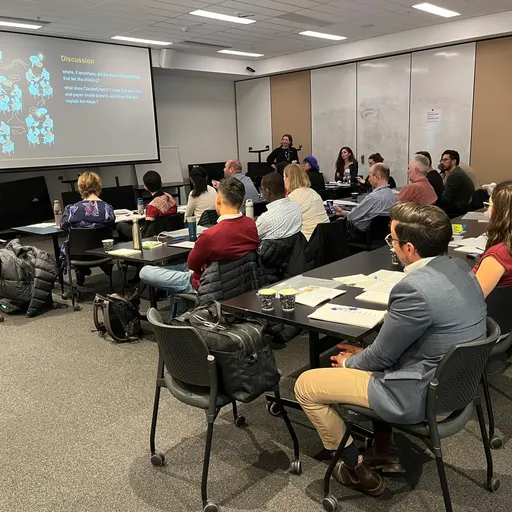
We did what we always do.1 The participants tallied token frequencies, filled in the probability grid, and generated new text by rolling dice against the counts. It’s the same statistical machinery that sits underneath ChatGPT, slowed right down to human speed and built out of paper and dice.
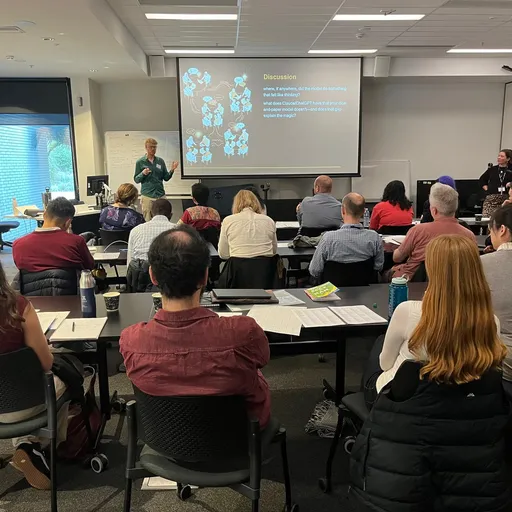
The early responses to the post-workshop survey have been generous about the hands-on approach, gratifying for a session pitched at serious scholars from outside the discipline of Computer Science. Thanks to the co-chairs, Thiago Nascimento da Silva and Constanza Sanhueza Petrarca, for the invitation. Thanks too to my co-facilitators Cole and Eddie. If you work with a group of researchers who would like an honest, hands-on feel for how these models actually work, do get in touch.
Footnotes
-
It is, give or take, the same activity we ran with a Year 5 class at Duffy Primary a couple of weeks earlier. ↩