RLHF
Key idea: Human feedback can tune a model's probabilities without new training data, by rewarding preferred outputs.
Adjust your Language model A system that predicts what text comes next based on patterns learned from training data. Your hand-built grid or cutouts spread is a language model. View in glossary based on human preferences, reinforcing outputs people like and discouraging ones they don’t.
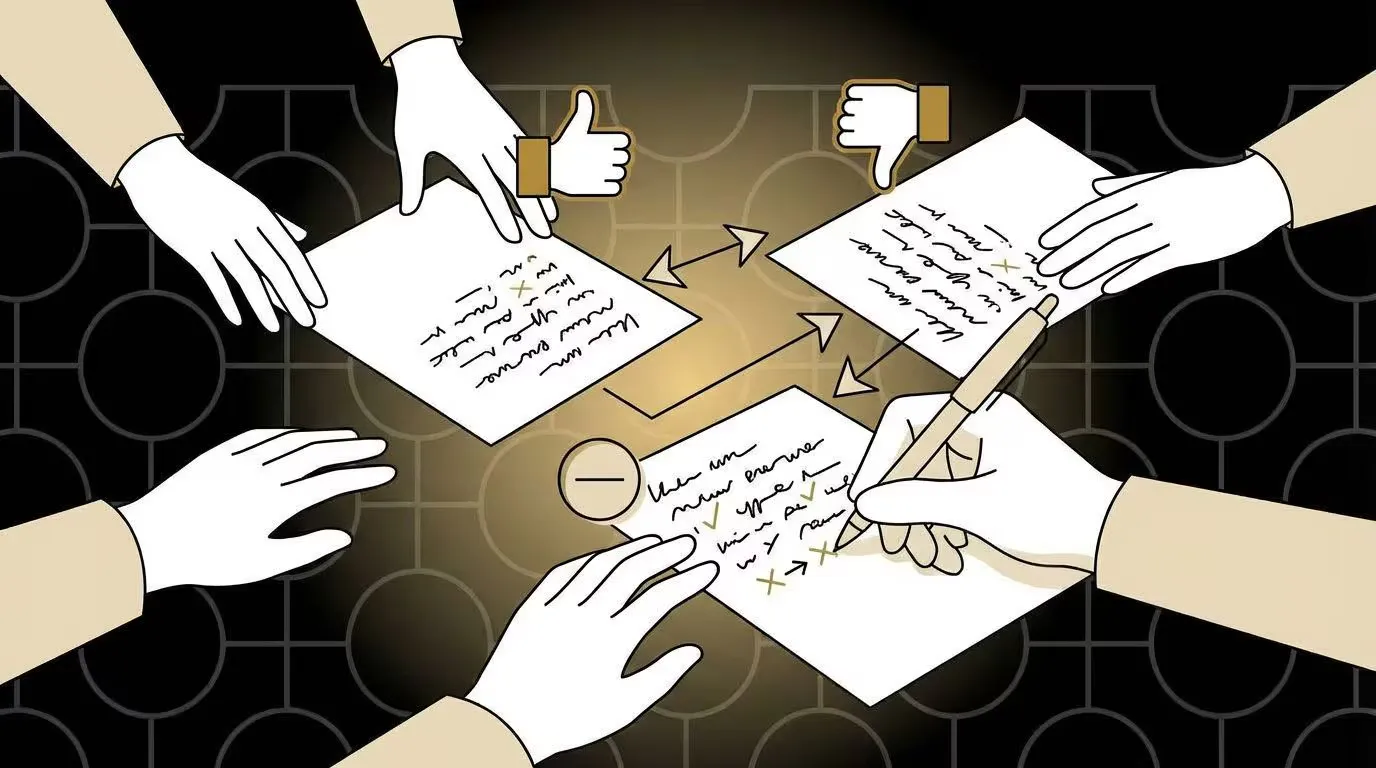
You will need
- a completed model from an earlier lesson
- pen, paper, and dice as per Generation (grid method)
- a group of people to provide preferences (the “humans” in RLHF)
Your goal
Generate multiple candidate outputs, collect human preferences, and update your model’s counts accordingly. Stretch goal: run multiple rounds of feedback and observe how the model changes.
Key idea
RLHF (Reinforcement Learning from Human Feedback) A post-training technique where humans compare pairs of model outputs and their preferences train a reward model, which then guides the main model. Suits fuzzy objectives like "be helpful" or "sound natural" where no automated checker exists. Sibling of RLVR, which uses an automated checker instead of human preferences. View in glossary adjusts model probabilities based on what people prefer. Instead of training on more text, you train on human judgements about which outputs are better.
Algorithm
Phase 1: generate candidates
- Choose a starting word.
- Generate 2–3 different completions (5–10 words each) by running generation multiple times from the same starting point.
- Write each candidate on a separate piece of paper.
Phase 2: collect preferences
- Show all candidates to your human judges (the class, a small group, or individuals).
- Have them vote on which completion they prefer.
- Record the ranking: best, middle, worst.
Phase 3: update the model
For each word transition in the preferred output:
- add +1 to that cell in your grid
For each word transition in the rejected output:
- subtract 1 from that cell (minimum 0)
Middle-ranked outputs: no change (or +0.5/−0.5 if you want finer adjustments).
Phase 4: generate again
Use the updated model to generate new text. The adjustments should make preferred patterns more likely.
Example
Starting word: “the”
Candidate A: “the cat sat on the mat.” Candidate B: “the dog ran to the park.” Candidate C: “the the the the the the.”
Human preference: B > A > C
Updates:
- B’s transitions get +1 each: (the→dog), (dog→ran), (ran→to), (to→the), (the→park), (park→.)
- C’s transitions get −1 each: (the→the) loses 5 counts
- A stays unchanged (middle rank)
After updates, “the→dog” and “the→park” become more likely, while “the→the” becomes much less likely.
Running multiple rounds
For deeper learning, repeat the process:
- Generate new candidates from the updated model
- Collect fresh preferences
- Update again
- Observe how the model’s behaviour shifts
After several rounds, the model should consistently produce outputs more aligned with human preferences.
Instructor notes
Discussion questions
- what makes one output “better” than another? can people agree?
- what happens if different people prefer different things?
- how many rounds of feedback does it take to noticeably change the model?
- could you “break” the model with bad feedback?
- what biases might creep in through human preferences?
- is the model learning to be “good” or learning to match what judges prefer?
Classroom variations
Simple version: just pick best vs worst (ignore middle). Easier to run, same core concept.
Split judges: divide the class into groups with different preferences (e.g., “team poetry” vs “team clarity”). Train separate models and compare results.
Blind feedback: judges don’t know which outputs came from which version of the model. Reduces bias toward “improvement.”
Adversarial feedback: one judge deliberately gives bad feedback. How robust is the process?
Connection to current LLMs
RLHF is how modern AI assistants learn to be helpful, harmless, and honest:
- Claude Anthropic's LLM chatbot. The concepts on this site apply equally to Claude, ChatGPT, Gemini, and other LLMs---the underlying principles are the same regardless of which product you use. View in glossary , ChatGPT OpenAI's chatbot, and probably the most well-known LLM product. On this site we often use "ChatGPT" as shorthand for any modern LLM chatbot---the concepts apply equally to Claude, Gemini, DeepSeek and others. The underlying principles are the same regardless of which product you use. View in glossary , and others: all use RLHF to Alignment The process of shaping a model's outputs to match human values and preferences (typically helpfulness, harmlessness, and honesty). RLHF is one of the main techniques used to align modern LLMs. View in glossary model outputs with human values
- the process: human raters compare model outputs and rank them, exactly like your classroom judges
- Reward model A separate model that learns to predict human preferences, then guides the main model during RLHF. Rather than asking humans to rate every output, the reward model rates outputs at scale, trained on a smaller set of human comparisons. View in glossary : at scale, a separate AI learns to predict human preferences, then guides the main model
- safety: RLHF teaches models to refuse harmful requests by having humans prefer refusals over compliance
- instruction following: models learn to actually answer questions (rather than just predict text) through RLHF
The key insight: RLHF shifts what “good” means from “matches training data” to “matches human preferences.” Your grid updates demonstrate this directly—you’re changing probabilities not based on what appeared in text, but based on what people preferred. This is why RLHF-trained models can be more helpful than models trained only on internet text: they’ve learned to optimise for human approval, not just pattern matching.
The limitation is also visible: RLHF captures the preferences of whoever provides feedback. Different judges produce different models. This is why AI companies carefully select and train their human raters—the model will learn whatever biases and preferences those humans have.